
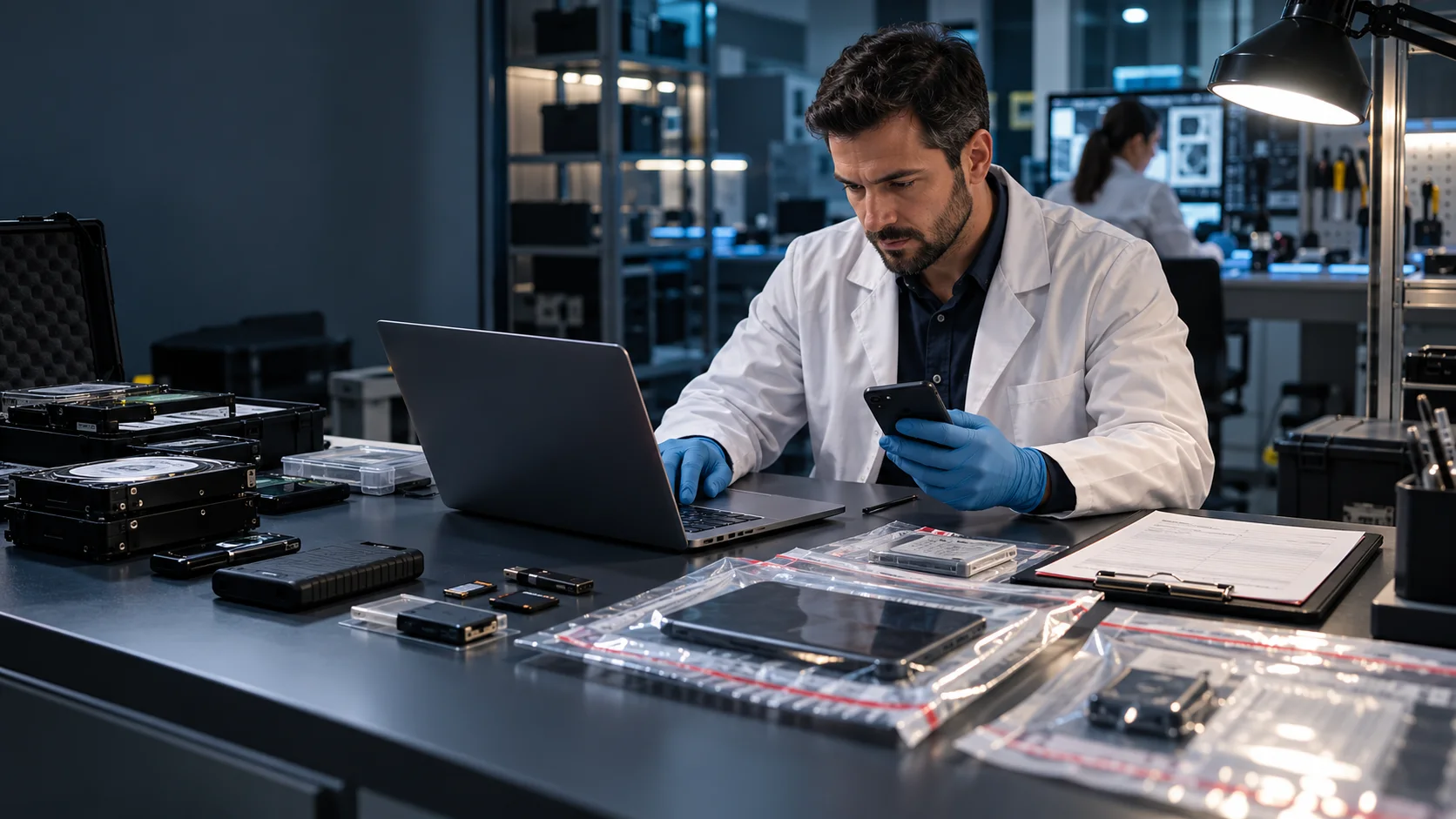
Chain of custody is the documented, unbroken record of who handled a piece of evidence, when they handled it, and what they did with it. In digital forensics, that evidence is usually a phone, laptop, hard drive, cloud account, or a copy of data pulled from one of those sources. The record is what allows a court, an opposing party, or an investigator to trace the evidence from the moment it was identified to the moment it is presented.
The short answer to the question most people are really asking: chain of custody does not, by itself, prove that a file is authentic or that a device was used by a particular person. What it does is support a claim that the evidence has not been altered, swapped, or mishandled since it was collected. Authenticity and attribution are separate questions, answered by other forensic work. Chain of custody is the foundation that makes those answers credible.
This article explains how chain of custody works for digital evidence, why it matters in litigation and internal investigations, how it is built in practice, where it commonly breaks down, and when to involve a professional. It is general information, not legal advice; questions about admissibility in a specific matter should go to a licensed attorney.
Why chain of custody matters more for digital evidence
Physical evidence like a signed contract or a weapon is relatively stable. Digital evidence is not. A file can be opened, edited, copied, or deleted without leaving an obvious mark. A phone can sync to a cloud account and change its own contents. A laptop can install updates, run background processes, or overwrite deleted data simply by being turned on.
Because digital evidence is easy to change, even accidentally, the record of handling carries extra weight. Courts and opposing counsel want to know:
- Who first identified the evidence, and under what authority?
- Was the original preserved, or only a copy?
- What tools and methods were used to collect it?
- Who had access to it afterward, and how was that access controlled?
- Can the evidence be shown to be the same today as when it was collected?
A well-kept chain of custody answers those questions with documentation rather than memory. That matters because memory fades, staff turn over, and litigation can stretch over years.
What a chain of custody record actually contains
There is no single mandated form, but a usable record generally includes the following for each item:
- Description of the item. Make, model, serial number, storage capacity, and any distinguishing marks. For data rather than a device, describe the source and scope.
- Date, time, and location of collection, including the time zone.
- Collector identity and the authority under which collection occurred, such as consent, a subpoena, or a court order.
- Method of collection. For example, a forensic image of a drive, a logical extraction of a phone, or an export from a cloud service.
- Hash values computed at collection and verified afterward. A hash is a short digital fingerprint of a file or drive; if the content changes, the hash changes.
- Storage location and access controls for the original and any copies.
- Every transfer with signatures or logged acknowledgments from the person releasing and the person receiving the item.
- Every access event after collection, including who opened the evidence, why, and what was done.
The goal is continuity: a reader should be able to follow the evidence from collection to courtroom without a gap that requires guesswork.
How chain of custody is built in practice
1. Identify and secure the source first
Before anything is copied, the source should be secured. For a device, that often means isolating it from networks so it cannot receive remote commands or sync new data. For a cloud account, it may mean preserving account logs and exports before retention periods expire. Deciding what to preserve, and in what order, is often the most consequential step in the entire process.
2. Preserve the original and work from copies
Standard practice is to create a forensic copy, often called an image, and perform analysis on the copy while the original stays sealed and stored. The image is verified against the original using hash values. If the original must be examined directly, that access is documented.
3. Document as you go, not afterward
Contemporaneous notes are far more persuasive than a reconstruction written weeks later. Times, tool versions, and observations should be recorded at the moment they occur. A gap that is explained in the record is usually far less damaging than a gap that is discovered by the other side.
4. Control physical and logical access
Evidence should be stored where access is limited and logged. Digital evidence adds a second layer: access to the analysis environment, the case files, and any shared drives should also be controlled. A perfect physical log means little if anyone on the network can open the evidence folder.
5. Verify integrity at each handoff
Recomputing hash values when evidence changes hands or storage locations confirms that the copy still matches the original. Any mismatch should be investigated and documented immediately rather than quietly resolved.
Where chains of custody commonly break down
Most problems are ordinary rather than dramatic. Common weak points include:
- Informal collection by IT staff. An employee copies files to a USB drive to be helpful, without documenting the source, time, or method.
- Devices left running or connected. A phone that stays online can receive messages, install updates, or sync with a cloud account, changing the evidence after collection.
- Shared credentials and shared drives. If several people use the same login, access cannot be attributed to an individual.
- Missing or inconsistent timestamps. Time zone errors and clock drift create confusion about sequence.
- Retention gaps. Cloud providers and messaging platforms delete data on their own schedules, sometimes before anyone thinks to preserve it.
- Undocumented analysis. An examiner who cannot describe the tools and steps used weakens the value of otherwise sound findings.
None of these necessarily destroys the evidence, but each creates questions that the record should have answered.
Chain of custody and the law: what to understand
Rules about authentication and admissibility of evidence vary by jurisdiction, by court, and by the type of proceeding. In general terms, the party offering evidence must be able to show it is what it claims to be, and chain of custody is one of the ways that showing is made. Courts often weigh the strength of the record rather than demanding perfection; a documented, explained gap may be treated differently from an unexplained one.
Because the standards differ and because procedural rules can be unforgiving, this is an area where attorneys should be consulted early. A forensic examiner can describe methods and integrity checks; the legal argument about whether evidence is admissible belongs to counsel.
Practical steps for businesses and individuals
If you expect a dispute, an investigation, or litigation involving digital evidence, the following steps reduce risk:
- Preserve early. Once a dispute is reasonably anticipated, stop routine deletion and issue a written preservation instruction to anyone who may hold relevant data.
- Do not investigate informally. Resist the urge to browse a departing employee's laptop or a shared drive before preservation. Casual access can alter metadata and undermine later findings.
- Keep the original untouched. If you must copy something, note what you copied, from where, when, and with what tool.
- Record everything in writing. Names, dates, times, and actions. A simple log maintained consistently is better than a sophisticated system used sporadically.
- Store evidence securely. Limit access, log it, and keep originals separate from working copies.
- Involve a professional when stakes are high. Matters involving employment claims, contract disputes, intellectual property, or potential criminal exposure usually justify a forensic examiner from the start.
Our digital forensics practice handles preservation and examination of devices, accounts, and data, and our expert witness work includes explaining methodology and integrity checks in plain language. For matters that also involve security incidents or unauthorized access, see our cybersecurity services.
When to bring in professional help
Consider a forensic examiner when any of the following applies:
- The evidence may be used in litigation, arbitration, or a regulatory proceeding.
- A device may contain deleted data that matters.
- Data lives in cloud services or messaging platforms with short retention windows.
- An internal investigation could lead to termination, a claim, or a referral to law enforcement.
- You need an independent record that will withstand scrutiny from opposing counsel.
Engaging help early is usually less expensive than repairing a broken record later. If you are unsure whether a situation calls for forensic preservation, a short consultation can clarify the options. You can reach us through our contact page; for matters that also require background or witness work, our private investigator team can coordinate.
Frequently asked questions
Does a broken chain of custody automatically make evidence inadmissible?
Not automatically. Courts generally consider the nature of the gap, whether it is explained, and whether other evidence supports authenticity. A documented, minor gap is often treated differently from an unexplained one. Admissibility is a legal question for the court and for counsel to argue.
Is a hash value the same thing as chain of custody?
No. A hash value is a digital fingerprint that helps show a file or drive has not changed. Chain of custody is the broader record of handling, access, and transfers. Hash values are one important component of a well-built record, not a substitute for it.
Can I just screenshot messages or copy files myself?
You can, but screenshots and informal copies are weak evidence because they do not capture the underlying data, metadata, or context. If the material may matter in a dispute, preservation by a trained examiner is more reliable and easier to defend.
How long should digital evidence be retained?
Retention depends on the matter, applicable rules, and any preservation obligations. In litigation, evidence should generally be kept until the matter concludes and any appeal periods expire. Your attorney can advise on specific obligations.
What if the device was already used after the incident?
Continued use does not necessarily make evidence useless, but it complicates the picture. An examiner can often identify what changed and when, and document the limits of what can be concluded. The earlier a device is preserved, the more options remain.